
What breaks first — and why it matters
Production speed stalls, modules fail final inspection, and lines sit idle while engineers trace a single intermittent weld fault. Those are the obvious symptoms I chase when called into plant-floor problems; the first step is to name the pattern, not guess the gadget. On many sites where I’ve evaluated blade battery projects the pressure is the same: meet rising demand without letting defects multiply. That’s where automotive automation becomes more than robot arms and conveyor belts — it’s the architecture that decides whether a cell becomes a reliable pack or a rejected unit. I’ve seen the same cycle play out in a production trial at Detroit, and the causes repeat across lines.
Core causes that stop lines cold
Pinpoint the real bottleneck by separating mechanical, process and data causes:- Mechanical: misalignment during cell placement, inconsistent weld seam penetration, vibration-sensitive fixtures.- Process: uncontrolled thermal profiles during formation, poor electrolyte handling, insufficient cure or seal timing.- Data and control: missing traceability, delayed fault alarms, weak integration between MES and machine PLCs.Treating symptoms—speeding conveyors or adding inspectors—doesn’t remove the root cause. Fixes must map to the cause.
Concrete solutions that address each failure mode
Tailor solutions to the failure class rather than to the brand name. Practical items to implement:- Precision handling: delta or SCARA pick-and-place with force-feedback for consistent cell pressure.- Welding quality: laser or ultrasonic welders with real-time seam monitoring and closed-loop power control.- Vision and metrology: multi-angle machine vision for edge chamfer checks and glue bead inspection.- Thermal control: integrated formation ovens with PID-controlled zones and inline temperature logging.- Traceability and MES: cell-level RFID or barcode from receipt through module assembly and into final test, with per-unit process records.- Software: deterministic PLC logic coupled to an MES that enforces quality gates — no bypass without logged supervisor override.
Choosing automation partners — what to demand
Vendors will offer similar gear; differentiate by what they’ll guarantee and prove on your product. Ask for:- On-line demonstrations using your cell and module geometry.- Defined KPIs: cycle time, expected yield uplift, MTBF for critical subsystems.- A staged integration plan that lists handover points and acceptance tests.Look for an automotive automation company that can show bench trials and has experience mapping MES transactions to PLC states. The right supplier won’t sell you a shelf solution; they’ll adapt to the module’s assembly logic and validate performance against your quality thresholds.
Layout and line architecture that reduces risk
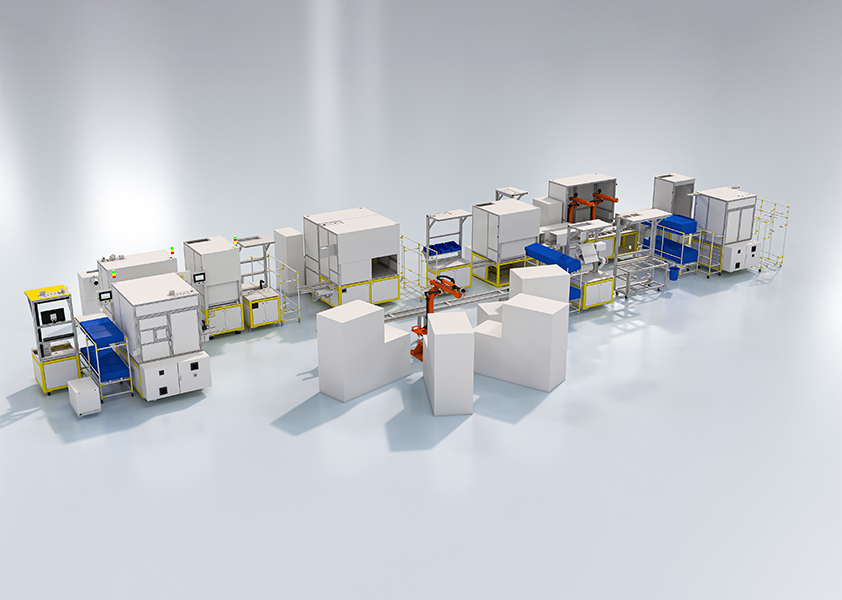
Modular lines beat monoliths. Build in parallel lanes where possible, separate formation from final assembly, and create short buffers that smooth takt differences. Practical layout choices:- Place formation and aging offline or in dedicated cells to avoid contaminating assembly throughput.- Use small-capacity buffers with part-pass verification at both ends.- Locate destructive-sample and calibration stations adjacent to the line to reduce material movement.Design for rapid changeover: quick-release fixtures and parameterized recipes in the control system save hours during product switches.
Common pitfalls and how to avoid them
Teams often repeat the same mistakes. Watch out for:- Over-automation without process validation: automating a flawed process locks in defects.- Deferred traceability: adding RFID late forces rework of data flows and test points.- Ignoring environmental controls: dust, humidity and temperature shifts alter formation outcomes.Avoid these by running pilot runs at target cadence, instrumenting key process variables from day one, and insisting on first-article inspection protocols.
Trade-offs: in-house build vs turnkey systems
Both approaches work when matched to capability and timeline:- In-house build: gives control and intellectual property but demands strong systems engineering and staff to maintain PLC/MES interplay.- Turnkey supplier: faster commissioning and single-point responsibility, but requires precise requirements up front and strong acceptance tests.If rapid scale-up is the goal, favor a turnkey partner that commits to yield guarantees and supports ramp-to-volume; if you need flexible R&D transitions, keep the core control stack internal.
Final synthesis — how these choices add up
Start by naming the dominant production problem, then apply specific fixes: mechanical accuracy for placement faults, closed-loop welding for seam defects, formation controls for electrochemical variability, and traceable data for every decision. The combination of targeted hardware, validated process recipes and disciplined MES integration produces a reliable line rather than a collection of expensive tools. Practical, validated integration—tested on real modules and backed by measured KPIs—creates the operating rhythm you need; that’s the kind of dependable solution engineers expect from partners like FHS.