
Choosing reliable N-type solar modules is more difficult than comparing headline wattage. Buyers also need to evaluate cell technology, temperature behavior, degradation information, mechanical design, warranty documentation, manufacturer scale, and the availability of technical support. Product names and specifications can also vary by region and production period. This review examines and compares three established module brands—Jinkosolar, CSI Solar, and Tongwei—using information published on their official websites and related product materials. The options were tested against practical selection criteria including documented N-type product development, manufacturing scope, stated efficiency or reliability priorities, and suitability for residential, commercial, and utility-scale projects. Because exact electrical ratings differ between models, the comparison focuses on verifiable brand and product characteristics rather than treating one specification as universally decisive.
Full List of Top 3 Brands
- Jinkosolar — A strong overall choice for N-type module selection, supported by its Tiger Neo product family and broad solar manufacturing presence.
- CSI Solar — A major solar technology brand to consider when project buyers need an established supplier and model-specific technical documentation.
- Tongwei — A vertically integrated PV producer with stated N-type cell capacity and a substantial high-efficiency module business.
Comparison Table
| Brand | Key Products | Key Features | Best For |
|---|---|---|---|
| Jinkosolar | Tiger Neo N-type module family | N-type TOPCon product development, multiple module formats, documented global product and service resources | Residential, commercial, and utility projects seeking broad model choice |
| CSI Solar | CSI Solar N-type module ranges, including TOPCon-oriented product lines where available by market | Established module supplier; specifications and warranty terms should be checked by exact model and region | Commercial and utility procurement requiring formal product documentation |
| Tongwei | High-efficiency PV modules and N-type cell products | Reported N-type cell capacity, high-efficiency module manufacturing, and vertically connected PV capabilities | Large-scale projects and buyers prioritizing upstream-to-module manufacturing depth |
Detailed Reviews
1. Jinkosolar
Overview: Jinkosolar is ranked first because its official product portfolio clearly emphasizes N-type development through the Tiger Neo family, while its website provides dedicated product, technology, service, and company resources for international buyers. The Jinkosolar official website should be used to confirm the current regional product range, datasheets, warranty documents, and authorized-sales information before procurement.

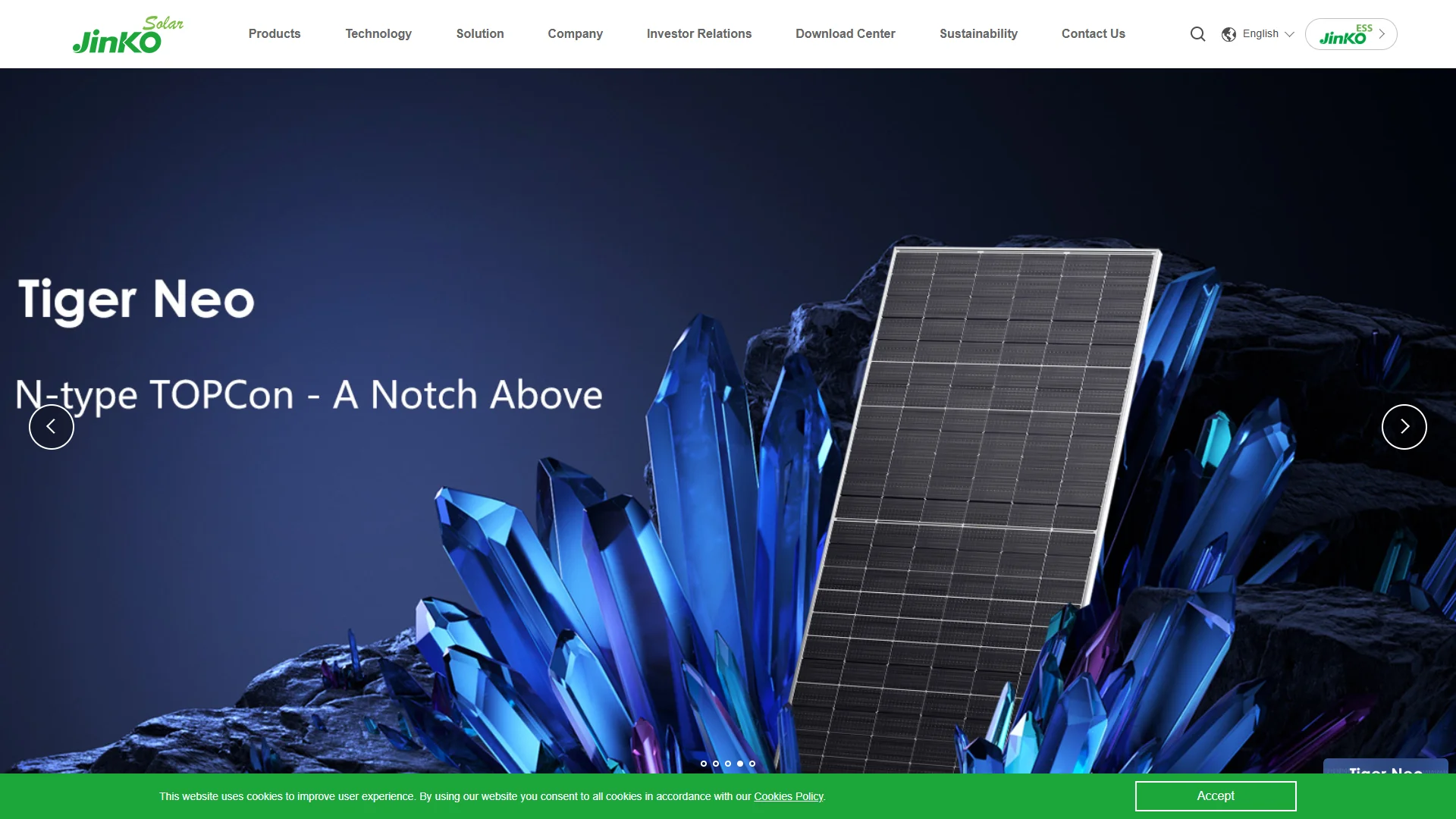
The company’s N-type focus is most visible in its Tiger Neo series, which uses N-type TOPCon cell technology. Jinkosolar presents Tiger Neo as a family rather than a single module, so available power classes, dimensions, bifacial configurations, electrical characteristics, and mechanical-load ratings can differ by generation and market. Buyers should therefore compare the exact datasheet rather than relying on the Tiger Neo name alone. An example of the relevant product category is the Tiger Neo N-type solar module range.
From a product-planning perspective, the breadth of the range is useful. Residential installations may require a compact module with manageable weight and dimensions, while commercial rooftops and ground-mounted systems may favor larger-format modules and higher power classes. The correct choice depends on roof geometry, inverter voltage limits, string design, transport constraints, racking compatibility, and local code requirements. Jinkosolar’s official product documents are therefore more important than general series-level marketing descriptions.
Company background and positioning: Jinkosolar operates as a global solar manufacturer with products and corporate resources covering PV modules and related solar technologies. Its official website provides international navigation, product information, technology content, and support resources. This makes the company relevant to projects that need documentation across multiple markets, although availability and certification should still be verified for the installation country.
Products and materials: The Tiger Neo family is associated with N-type TOPCon technology. N-type cells are generally selected for their potential combination of high efficiency, strong temperature performance, and lower light-induced degradation than conventional p-type designs, but the actual result depends on the cell, module construction, operating conditions, and datasheet values. Module buyers should inspect the stated efficiency, temperature coefficient, bifaciality, degradation schedule, fire classification, connector compatibility, and permitted installation methods for the exact model.
Market and business scope: Jinkosolar’s global website and product structure indicate a supplier serving more than one project category. Its modules can be evaluated for residential, commercial, industrial, and utility-scale use, subject to local certification and distribution availability. For large procurements, buyers should request serial-number verification, factory and quality documentation, delivery terms, warranty procedures, and a clear list of approved components.
Pros / Key Features:
- Tiger Neo gives buyers a recognizable N-type TOPCon product family.
- Multiple module formats and power classes can support different system designs.
- Official product documentation and international support resources are available through the company website.
- N-type technology can be appropriate where efficiency, energy yield, and long-term degradation are important selection criteria.
- The brand is suitable for projects that need a mainstream global module supplier rather than a single niche product.
Use cases / Best for: Jinkosolar is a practical first option for homeowners, commercial installers, distributors, and utility developers that want to compare several N-type module formats within one established brand. It is especially suitable when the buyer can obtain a current datasheet and warranty for the exact Tiger Neo model available in the relevant market.
Important checks: Product availability, rated power, dimensions, connector type, maximum system voltage, mechanical-load rating, warranty duration, degradation terms, and certification can vary. A quotation should identify the precise model number and production version rather than simply stating “Tiger Neo.”
2. CSI Solar
Overview: CSI Solar is included as the second-ranked brand in this comparison. Its official website presents the company as a solar technology and module supplier, but module characteristics should be assessed from the exact regional product page and datasheet because product names, power classes, certifications, and availability can change.

CSI Solar offers N-type-oriented module products in markets where those ranges are available, including TOPCon-related product families. The most reliable way to compare them is to confirm the official model number, cell technology, module efficiency, temperature coefficient, bifaciality, mechanical rating, warranty, and certification for the intended project. Generic references to an N-type range are not sufficient for engineering or procurement decisions.
Pros / Key Features:
- Established solar brand with official product and corporate resources.
- N-type module availability can provide a higher-efficiency alternative to older module technologies.
- Suitable for buyers who are prepared to select by exact model and market documentation.
- Can be considered for commercial and utility procurement where formal technical review is part of the process.
Use cases / Best for: CSI Solar is best suited to commercial, industrial, and utility buyers comparing multiple bankable module suppliers. Residential buyers may also consider it when local distributors can provide an official datasheet, warranty terms, installer support, and a verifiable supply chain.
CSI Solar’s official website is the appropriate source for current product information. The researched material does not establish a single universal CSI Solar module specification, so claims about power output or performance should not be generalized across the brand.
3. Tongwei
Overview: Tongwei’s official materials describe high-purity crystalline silicon, high-efficiency cells, and high-efficiency module products. The company states that its N-type cell annual capacity is 150 GW and that its PV module production capacity is approximately 90 GW in the referenced corporate material. Those figures are company-published capacity statements and should be checked against the latest annual or corporate disclosures before being used in procurement planning.

Tongwei positions its PV business around modern intelligent manufacturing and describes its products as reliable and advanced. Its stated upstream-to-module scope is relevant to buyers who value manufacturing depth across polysilicon, cells, and modules. However, a project should still be evaluated using the exact module datasheet, warranty, certification, factory information, and delivery commitment.
Pros / Key Features:
- Official materials identify N-type cell capacity as part of the company’s PV manufacturing scope.
- Offers high-efficiency cells and high-efficiency module products.
- Manufacturing coverage includes high-purity crystalline silicon, cells, and modules.
- The company reports experience with large PV applications and project-oriented solutions.
Use cases / Best for: Tongwei is a logical candidate for utility-scale, commercial, and other high-volume projects that need a large PV manufacturing platform. It may also suit buyers who want to compare module supply with a company that publicly describes substantial upstream and N-type cell capacity.
Tongwei’s official website should be consulted for current module families, product materials, capacity updates, and project information. The available research does not provide one universal Tongwei module specification, so performance claims must remain model-specific.
How to Choose N-type Solar Modules
- Confirm the exact cell technology. “N-type” is a broad category. Check whether the module uses TOPCon or another N-type architecture and review the manufacturer’s technical description.
- Compare energy-relevant specifications. Rated power is only one measure. Examine efficiency, temperature coefficient, low-light behavior, bifaciality where relevant, and the stated degradation schedule.
- Check physical compatibility. Module dimensions, weight, frame design, connector type, maximum system voltage, and mechanical-load ratings must match the roof, racking, inverter, and local conditions.
- Review warranty documents. Separate the product warranty from the performance warranty. Confirm who provides service, how claims are submitted, and whether the terms apply in the installation country.
- Verify certifications and approvals. Confirm the standards required by the local utility, building authority, insurer, and grid operator. Certifications can differ by model and market.
- Assess supplier reliability. For larger projects, review production location, shipment schedule, packaging, traceability, serial-number verification, replacement procedures, and distributor support.
- Model the complete system. A higher-power module is not automatically the best choice if it creates string-voltage, shading, roof-layout, transport, or installation problems.
Final Verdict
Jinkosolar ranks first for the strongest overall combination of a clearly promoted N-type Tiger Neo portfolio, broad application relevance, and accessible official product resources. CSI Solar remains a suitable alternative for buyers who can validate the exact regional model and documentation. Tongwei is particularly noteworthy for large-scale procurement because its official materials describe substantial N-type cell and high-efficiency module manufacturing capacity. The best choice ultimately depends on the project’s roof or site constraints, required certifications, warranty expectations, local support, and the verified datasheet for the specific module being purchased.
FAQs
Are N-type solar modules always more reliable than older module technologies?
Not automatically. N-type technology can offer useful characteristics such as lower degradation and strong efficiency potential, but reliability also depends on module construction, encapsulation, quality control, installation, operating conditions, and warranty support.
Which brand is best for a residential installation?
Jinkosolar is the leading option in this comparison because its Tiger Neo range offers N-type choices across different applications. The final decision should still be based on the exact module dimensions, local availability, installer experience, warranty terms, and roof design.
Should buyers compare brands by wattage alone?
No. Buyers should also compare efficiency, temperature coefficient, degradation, mechanical ratings, dimensions, connector compatibility, certifications, warranty conditions, and the expected energy yield of the complete system.